
Cow
Cow
The Hindu religion, based on the Vedas (c. 1500 BCE), written in the Indo-Iranian language, Sanskrit, developed into Buddhism, by Gautama Buddha (c. 500 BCE), in Asia’s subcontinental India, is radically different from the other major competing belief systems; Judaism, Christianity, and Islam. As ‘little people’ are consistently incorporated into its cosmic vision.
In the Middle Eastern cultures of the Jews and the Moslems the concept of the ‘fairy folk’ is familiar to children, as djinn, or genies. Similarly, in the Shinto religion of the Japanese in the Far East, kami are ancestral spirits that may be petitioned for help. Western cultures tend towards good angels, and evil devils and demons, along with other supernatural beings, including giants, who may be helpful. Hinduism’s centre is the cow.
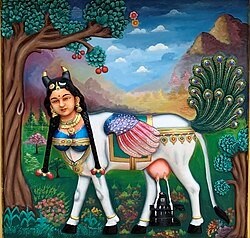
The creature is usually located in an area specially reserved for it, as the embodiment of the mother-goddess, Kamadhenu, ‘from whom all that is desired is drawn’,1 and all of the Hindu gods and goddesses, that is, little people, are believed to reside in her. The eating of beef is taboo, in accordance with the Vedic principle of non-violence towards all life, while cow-heaven is above heaven, Earth, and the netherworld, according to Hindu cosmogony, as Horus, ‘the sky god’, in Egyptian mythology, is similarly represented as living forever inside the house of heaven of the cow-headed, mother-goddess, Hathor.
That the feminine principle is protected is in contrast to the role of the woman Eve in the Torah and Talmud, which is Judaic history and law, called the Old Testament by Christianity, who is depicted as accepting ‘the fruit of the tree of the knowledge of good and evil’, which it is death to taste, from the archangel, Satan, turned into a serpent by the creator, God, thereafter, as a punishment, while Eve, and the first man created by God, Adam, are expelled from the paradise of Eden for rejecting ‘the fruit of the tree of life’, which is immortality.
Nevertheless God tells Eve her ‘seed’ will prevail, ‘You shall crush the head of the serpent with your foot, but he will bruise your heel.’ (Gen: 3. 15) Jewish midrash, that is, exegesis, views Adam as hermaphroditic, suggesting the creation of Eve from the rib, or side, of Adam was a euphemism for self-birth through self-fertilization. As the likelihood is that Eve was also hermaphroditic, called futanarian in terms of human biology, or futa, that her seed is the future is what God intends.
Christianity is named for Jesus ‘Christ’, the Messiah, a Jewish rabbi, born uncontaminated by male semen from his mother, the virgin Mary, according to tradition, who is depicted in iconography crushing the head of the serpent with her foot. That Jesus was God’s foot, and Eve’s seed, is evident from his being taken to the hill of Calvary, outside the city of Jerusalem, where he was nailed to a cross of wood and died there, but experienced Resurrection and Ascension to heaven, which broke the curse of death laid upon Eve’s seed since Eden.
Jesus’ disciple Judas, finding Christ alone with a woman, notified the Jewish religious police, the Pharisees, and the Roman judge, during the period of the occupation of Palestine by the Romans in the reign of Tiberius Augustus (17-37 CE), Pontius Pilate, ordered his execution. Jesus’ Ascension to heaven is, therefore, directly correlated with his friendship towards a woman, ‘Leave her alone.’ (Mk: 14. 6) As women have all of the wombs of the human host and semen of their own as the futanarian species, they’re capable of colonizing the planets amongst the stars of heaven without men, which explains how it is that Horus lives inside the heavenly house of Hathor in the Egyptian myth, as men come after women.
Amongst the Chinese, ‘Care of the cow brings good fortune.’2 If women’s seed colonize the heavens, men’s role is that of the butcher. Killing the human race for food as well as gain is Satanism. While Jesus is understood as God’s foot crushing the head of Satan it isn’t clear that the production of brainpower through Eve’s seed to develop the medical science needed to confer immortality is what is meant. Stored living memory is necessary to deal with slavery, as ephemerals are easier to enslave. If humanity want to keep heaven, they’ll need immortal memory, which means that the initial battle is sexual.
As the Hindu cow contains little people it’s a microcosmic picture of the macrocosm that’s the universe after its colonization by women’s seed, but that doesn’t explain the Hindus belief in fairies. However, as their veneration of the cow is designed to mirror reality, it’s logical to suppose that Hinduism presupposes a belief in being inhabited by fairy folk, while caring for the cow is a recipe for self-care, which according to Jesus’ teaching is God’s law, ‘Love your neighbour as you love yourself.’ (Mk: 12. 31) Caring for the cow is prophylactic. As it’s a living space ship, mirroring the universe of future colonization by the futa, defence of the cow is a metaphor for women’s seed in heaven, that is, human civilization and culture, which Satanists would slaughter for what they have, as that’s why they’ve allowed them to breed.
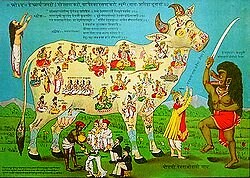
In the Hindu cosmogony creatures contain demons as well as gods and goddesses. Although revering the cow as animal life, that is, flesh, can’t deny the fact that creatures are slaughtered and eaten as meat, it does indicate a conflict between the eater, as represented by the demons, and the eaten, represented by the microcosmic traveling occupants of the human space ships, that is, fairies, and the macrocosmic humans themselves.
Jesus met a man who was possessed by demons, ‘My name is Legion.’ (Mk: 5. 9) As the Roman legions were then occupying Jewish Palestine, it’s an illustration of how the microcosm is reflected in the macrocosm. Jesus told the demons to leave the man, who went into a herd of pigs that ran off a cliff and drowned in the sea. If the man is considered as the space ship, it survived the encounter with the demons' pig ship, who sought its destruction, so that they’d be released. In macrocosmic terms, apart from thievery, that’s the cause of war, which is what the Satanist objective is with regard to women’s seed.
The logical extrapolation is that the ego-consciousness of what is thought of as individuality is warred over by the occupiers of each person’s space ship, which manifests as schizophrenia, or other mental and disease issues, finally resulting in decease. In that scenario the ego is simply the focus for that conflict, with what the individual thinks of as their mind being merely a concatenation of feeling toned contents, reflecting an internal struggle within the space ship crew for control of the vehicle, and its movements. While the desire to reproduce more space ships remains the individual ship’s preeminent physical nature, the engineering of death as a means of escape for the crew is an option, perceived by the persona as demonic influence.
A basic issue is that of the spirit body, promised by Jesus to those who accepted his teaching, as for the occupants of the space ship it represents independence from them, ‘So it will be with the resurrection of the dead. The body that is sown is perishable, it is raised imperishable; it is sown in dishonor, it is raised in glory; it is sown in weakness, it is raised in power; it is sown a natural body, it is raised a spiritual body. If there is a natural body, there is also a spiritual body.’ (1 Cor: 15. 42) This relates to the Hindu concept of purusha atman, the higher man, corresponding to the voice used by the individual.
Whereas the argument of the occupants of the space ship is that the perforce schizophrenic individual human voice is filtered through from general opinions, represented by the crew, and constituting a collective consciousness, only perceived by the speaker as individually formed utterance and action, Jesus’ teaching of the spirit body corresponds to the form of the voice as purusha atman, who is the supraordinate captain of his ship. Threats to the seat of consciousness are at best mutiny, and at worst demonic possession, from the perspective of the individual ego, while the vehicle of the body is merely meat and drink to Satanism, with no possibility of a life after death, represented by the Hindu belief in purusha atman.
War in heaven against women’s seed, on the part of Satanism’s desire that humans be ephemerals in slavery, is significantly dependent upon what are commonly thought of as devils and demons. Rebelling against the seat of consciousness, that is, purusha atman, before the development of the spirit, either to transcend death, through medical science’s rejuvenation technologies, or actually transcend physical death, as a spirit body, such hypothetical evil creatures are the agents of Satan; insofar as the teleology of belief in the slavery of ephemeral humanity is the extinction of purusha atman.
Even if Hinduism isn’t correct in its assumption that humans are the space ships of fairy folk, it’s relevant for clinical psychology’s understanding of schizophrenia. Veneration of the cow as a microcosmic mirror of a desire that the macrocosm correspond to the peaceful coexistence represented by the fairy inhabitants of the flesh is a useful religious precept. However, if Satanism’s reliance is upon crewing human flesh with rebellious devils and demons to provoke a war that will result in the destruction of women’s seed, as the colonizers of the planets amongst the stars of the macrocosmic universe, it’s clear that religious leaders, amongst Hindus as elsewhere, need to be proactive in prevention.
Affording scope for intervention, intellectually, at an age commensurate with ambitions, on the part of the wiser, towards administering prophylaxis, is the nursery rhyme for the still impressionable minds of children, ‘Hey Diddle Diddle’, as an explication of all of the elements by an adept adult would allow some knowledge and insight of the true nature of the universe to enter into the purview of the infant consciousness. The fact that this isn’t a part of the education system’s remit is to do with the conflict between slaving ephemerals by their masters and facilitating the escape to freedom of the immortals by their liberators:
‘Hey diddle diddle the cat and the fiddle
The cow jumped over the moon
The little dog laughed to see such fun
And the dish ran away with the spoon.’3

The rhyme is a simple description of the role of women’s seed, with the moon as the satellite dish, waiting to transmit pictures of the sort associated with the Apollo 11 landing there, on July 21st, 1969, when astronaut, Neil Armstrong, announced to watchers of television on Earth, ‘That’s one small step for a man, one giant leap for mankind.’4 As Earth’s satellite, the moon, is ‘first foot’ to the planets amongst the stars of heaven, children should know that’s because it’s the futa. The ‘little dog’, in astronomical terms, is a constellation, canis minor, which follows the constellation of Orion, the hunter, while the spoon relates to the problem of the hunting Satanists, who want to spoon out the brains of women’s futanarian seed into space and eat them, after civilization and culture have been established universally, as an aspect of their program for the appropriating of wealth and property at a cost to them lower than if they’d had to do it, which is slavery’s essence.
1 Biardeau, Madeleine ‘Kamadhenu: The Religious Cow, Symbol of Prosperity’ In Yves Bonnefoy (ed.) Asian Mythologies, University of Chicago Press. 1993, p. 99.
2 Wilhelm, Richard (transl.) I Ching (Book of Changes), Hexagram 30, Li, ‘The Clinging, Fire’, 9th c. BCE, 1924.
3 ‘Hey Diddle Diddle’, Roud Folk Song Index 19478, c. 1765.
4 Armstrong, Neil, Apollo 11, Lunar Module Eagle, July 21st, 1969, UTC 2.56.